
Every time someone gets caught for an online crime, the news article usually says they were tracked down by their IP address. Every time a crime show has a hacker scene, somebody types furiously on a keyboard and announces they have traced the IP to a specific house. And every time both of those things happen, the real story behind how IP tracking actually works gets a little more wrong in the public imagination.
The short answer to whether police can track you by your IP address is yes, but it almost never happens the way TV shows it. There is no real-time map with a blinking dot. There is no instant trace. There is a slow, paperwork-heavy process involving subpoenas to internet service providers, retention windows, and a lot of inferred guesswork. Here is what actually goes on, what police can find out from an IP address, and what they cannot.
What an IP address actually tells someone
Before getting into law enforcement specifics, it helps to understand what information an IP address even contains. If somebody hands a stranger your IP, what can they learn just by looking it up?
A standard public IP lookup reveals:
- The country and region the IP is registered to
- The city (usually accurate in urban areas, often wrong elsewhere)
- The Internet Service Provider (ISP) that owns the IP block, like Comcast, Vodafone, Deutsche Telekom
- The Autonomous System Number (ASN) which identifies the network operator
- The connection type: residential broadband, mobile, datacenter, business line
- Whether the IP is associated with a VPN, proxy, or Tor exit node
- Approximate geolocation coordinates which usually point to the ISP's regional hub, not the subscriber
That is everything a public lookup will tell anyone, including the police. Notice what is not on the list: your name, your address, your phone number, your specific street, or the device you are using. The IP itself does not contain any of that information. Anyone who tells you they "found someone's exact address from an IP" using only a free lookup tool is exaggerating or lying.
What an IP address gives you is a starting point. To turn that starting point into a real person, you need access to records the ISP keeps internally. That is where law enforcement comes in.
The short answer: yes, but only with help from the ISP
When police track an IP to a person, the IP itself is doing none of the heavy lifting. What identifies the person is the ISP's internal record of which subscriber was assigned which IP address at which moment in time. That record is private. Police cannot just look it up. They have to ask, and the ask requires legal authorization.
Here is the chain of events when an IP-based investigation starts:
- Police get an IP address from a crime scene. This usually means logs from a website, social media platform, gaming server, or device that recorded the IP of someone involved in something illegal.
- They run a public lookup to find out which ISP owns that IP block. (A standard ip lookup does this in seconds.)
- They prepare a subpoena, court order, or search warrant directed at that specific ISP, requesting the subscriber information associated with that IP at that specific timestamp.
- The ISP receives the request and, after reviewing it for legal validity, returns the subscriber details: name, billing address, phone number, account history.
- Police now have a real person attached to the IP. From here they can investigate further, get warrants for the home, seize devices, and so on.
The IP is the breadcrumb. The ISP is the bakery. Without the ISP cooperating (and being legally compelled to do so), an IP address on its own is just a number.
How long does this take?
Faster than you would think for serious cases, slower than TV implies for everything else.
For urgent investigations (child exploitation, active threats, terrorism), police can sometimes get an emergency court order approved by phone in under an hour. ISPs have dedicated law enforcement liaison teams that respond to high-priority requests quickly, often within the same day. The whole pipeline from "got an IP" to "knocking on a door" can take less than 24 hours.
For routine investigations, the timeline is more like days to weeks. The subpoena has to be drafted, signed by a judge, served on the ISP, processed by thier legal team, and the data returned. Most ISPs respond within 2 to 4 weeks for non-emergency requests. Some take longer.
For cold cases or anything older than the ISP's retention window, the answer can be "never". More on retention windows below.
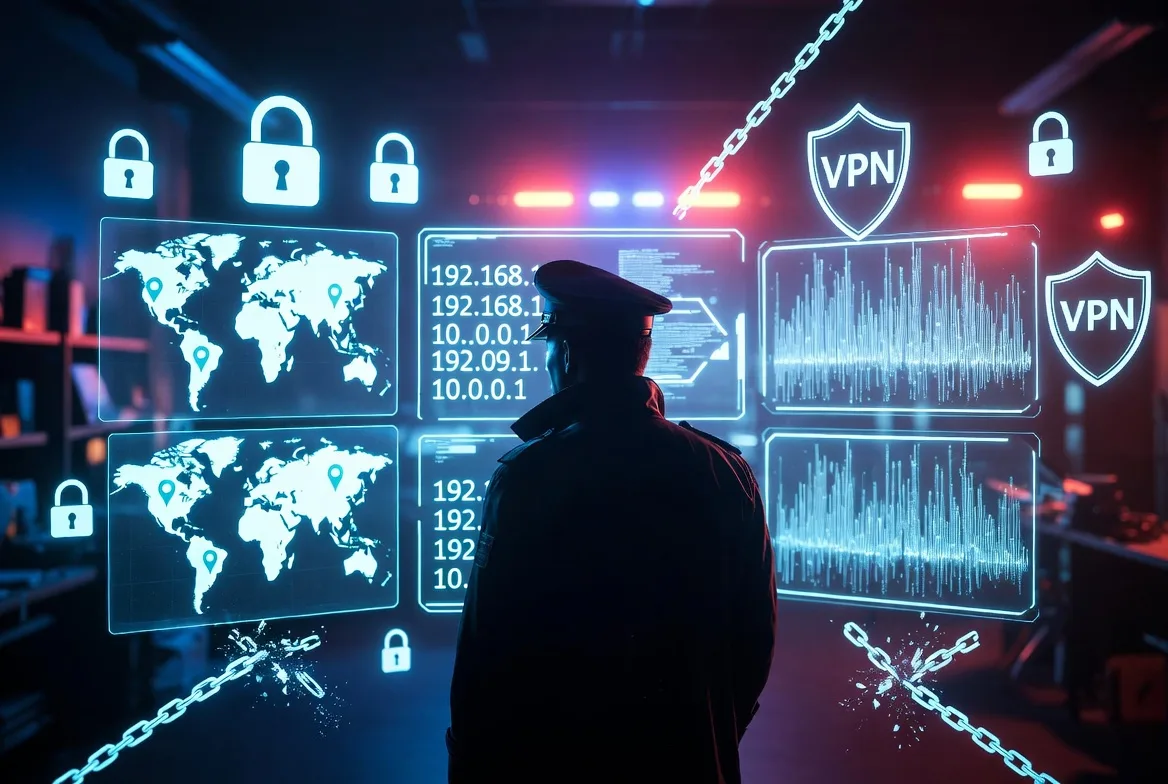 Browsing the internet by Police. AI grok image
What police see vs what they don't
This is the part people get most confused about. Here is the side by side reality.
| ✅ What police can typically get | ❌ What police cannot get from an IP alone |
|---|---|
| Subscriber name and billing address | What was on your screen |
| ISP account history | The content of encrypted (HTTPS) traffic |
| Connection timestamps | Which person in the household used the device |
| Approximate connection location | Searches inside Google, Bing, etc. (without a separate warrant to the search engine) |
| Whether a VPN was used | The actual contents of your VPN traffic |
| Volume of data transferred | What you said in encrypted messengers (Signal, WhatsApp) |
| Which sites you connected to (domain level, with court order) | Encrypted backups stored only on your device |
Notice the pattern. The IP and ISP records prove connection metadata, not content. They prove that a certain household's internet line was active and connected to certain destinations at certain times. They do not prove what you were actually doing on those connections, especially in 2026 when nearly all web traffic is encrypted.
This is why a single IP address is rarely enough evidence to convict somone on its own. Courts treat IP-based identification as a starting point that has to be corroborated with other evidence (device seizures, forensic analysis, witness statements, surveillance, financial records). When you read about "police caught someone using their IP address", the IP was step one in a much longer chain.
The retention window: when records simply don't exist anymore
ISPs do not keep IP logs forever. Storage costs money and ISPs have no business reason to retain data beyond what is legally required or operationally useful. The retention period is the single biggest factor that determines whether an IP-based investigation can succeed.
Typical retention windows in 2026 (these vary by ISP and country):
- United States: No federal data retention mandate. Most major ISPs retain IP assignment logs for 6 months to 2 years. Comcast keeps around 180 days. Verizon retains 18 months. Charter currently keeps 6 months unless legally required to extend. Spectrum varies by region.
- European Union: The original Data Retention Directive was struck down by the Court of Justice in 2014, but most member states have their own laws. Common retention is 6 to 12 months, sometimes longer for specific data types.
- United Kingdom: Under the Investigatory Powers Act, ISPs retain internet connection records for 12 months.
- Australia: Mandatory 2 year retention of metadata under the Telecommunications Act.
- India: Minimum 1 year retention under government regulations, often longer in practice.
Once that retention window passes, the records that link IP to subscriber are typically overwritten or deleted. If a crime is discovered after the retention period, there may be no way to identify who held the IP at the time it was active. This is one of the main reasons stale cases are hard to crack with IP evidence alone.
There is a nuance worth knowing about. Even when an ISP says it deletes logs after one year, backup systems and archival storage can retain data longer than the stated policy suggests. Whether those backups are recoverable for law enforcement depends on internal procedures and the specific legal request. As a practical matter, anything older than the public retention window is usually treated as unrecoverable.
The VPN question: can police track you through a VPN?
This is the single most asked follow-up question on the topic, so it deserves its own section. The honest answer has nuance.
When you connect through a VPN, the destination website sees the VPN exit IP, not your real one. Police investigating an incident at that destination will trace the IP to the VPN provider, not to you. So far, the VPN did its job.
What happens next depends on the VPN provider:
No-logs VPNs (Mullvad, Proton VPN, IVPN, and others that have been audited): If police subpoena the VPN provider for the user behind a given exit IP at a given timestamp, the answer should be "we do not have that information". This has been tested in court multiple times. The catch is that "no logs" claims need to be audited and proven. Several VPN providers have advertised no-logs policies and then turned over user data when subpoenaed, because they did keep logs internally.
Logging VPNs: These keep records connecting users to sessions. Subpoena the VPN, get the user. Many free VPNs and some commercial ones fall into this category. Their privacy policy usually admits to logging connection metadata even if they claim "no activity logs".
The ISP angle: Even when a VPN does not log, your ISP can see that you connected to a VPN. They cannot see what you did inside the encrypted tunnel, but they know you used one, when, and for how long. If law enforcement is building a case, "the suspect was using a VPN at the time" is a data point they can establish from the ISP alone. It does not prove guilt but it can be part of the broader investigation.
Edge case attacks: For high-priority targets, law enforcement agencies in some jurisdictions have used traffic correlation attacks, where they monitor the VPN provider's incoming and outgoing traffic and statistically match patterns. This is expensive, requires significant resources, and is generally only deployed for major investigations. It is not something an average user needs to worry about, but it does mean the "VPN equals untraceable" assumption is wrong at the top tier of adversaries.
CGNAT, mobile, and shared IPs: when the IP can't identify a person
Modern internet infrastructure has made IP based identification harder than it used to be, and the trend is accelerating.
Carrier-Grade NAT (CGNAT) is when an ISP puts hundreds or thousands of customers behind a single shared public IP. This is now standard for mobile networks and increasingly common for residential broadband. If 500 customers share one IP, a subpoena for that IP returns 500 possible subscribers, not one. Police then need additional data (port numbers, exact timestamps to the millisecond, the destination server's logs) to narrow down which subscriber was responsible. Not all investigations have that level of detail, and not all CGNAT systems log enough internal mapping data to identify a single subscriber after the fact.
Mobile networks are particularly problematic. A mobile IP might rotate every few minutes. The same phone can show up under multiple IPs in a single session. Carriers do log this but the data is voluminous and requires precise timestamp correlation to be useful.
Public Wi-Fi disconnects the IP from any specific person. The IP belongs to the cafe, library, or airport. Police can trace it to that location but identifying the actual user requires camera footage, payment records, or other physical evidence.
Shared household connections mean the subscriber name is one person but anyone in the household (or their visitors, or their neighbors using guest Wi-Fi, or hackers who got onto the router) could have generated the traffic. The IP identifies the connection, not the human.
Tor exit nodes are a seperate problem. Traffic exiting through Tor looks like it came from the exit node operator's IP. That operator is identifiable, but they are usually a volunteer or organization unrelated to the actual user, and they have no records of who used their relay.
The cumulative effect is that IP based identification works best for cases involving dedicated residential lines used by individuals, and gets progressively less useful as you move toward shared, mobile, anonymized, or proxied connections.
What to do if you think your IP has been investigated
This is not legal advice and you should talk to a lawyer if your specific situation calls for it. That said, some general points are worth knowing.
If you genuinely have nothing to hide and police show up because of an IP based trace, the most common scenarios are mistaken identity (someone else used your network), a member of your household, or a security incident you were not aware of (router compromise, neighbor on your Wi-Fi, IoT device botnet). Cooperating with the investigation while keeping your devices off until you can consult a lawyer is the standard advice from defense attorneys.
If you are technical and worried about exposure, the meaningful steps are practical, not paranoid:
- Use WPA3 on your router with a strong password
- Disable WPS, which has had exploitable flaws for over a decade
- Change default admin credentials on your router (still a top route of compromise in 2026)
- Update router firmware periodically
- Audit which devices are on your network and recognize all of them
- Know whether your router has remote management enabled (it usually should not)
- Consider a guest Wi-Fi network for visitors and IoT devices that you do not fully trust
These steps do not make you untraceable. They just reduce the chance that your IP gets associated with activity you had no part in.
Country differences: how it works in the US, EU, and UK
The IP investigation process is similar everywhere but the legal procedures differ.
United States: Police need either a subpoena (for basic subscriber information) or a search warrant (for content, location data, or detailed records). The Electronic Communications Privacy Act sets the framework. ISPs cooperate but are legally required to validate the request. Constitutional protections under the Fourth Amendment apply to certain categories of data.
European Union: General Data Protection Regulation (GDPR) sets baseline privacy rules. Law enforcement access is governed by member state laws and the e-Evidence regulations. The process typically requires judicial authorization for non-emergency requests. EU residents have stronger formal protections than US residents but the practical process is similar.
United Kingdom: The Investigatory Powers Act 2016 governs surveillance and data requests. Internet connection records are retained for 12 months by law. Police can request subscriber information with appropriate authorization. The UK has somewhat broader powers than the EU due to specific national security provisions.
Cross-border cases are the slowest. When the IP is in one country and the crime is in another, mutual legal assistance treaties (MLATs) come into play. These requests can take months or years. This is why international cybercrime investigations are usually slower than domestic ones, and why criminals operating across borders are harder to catch.
Wrap up
The reality of IP based law enforcement is less cinematic than TV makes it look but more consequential than people assume. Police cannot type your IP into a magic console and see your address. They can, with appropriate legal process, ask your ISP for the records that link the IP to a billed account, and that process is reliable enough to put people in court rooms regularly.
The protections that actually matter are the ones built into the system. ISPs require legal process, not requests. Retention windows limit how far back investigations can reach. Encryption protects content even when metadata is available. VPNs add a real layer between you and destination logs, though they do not make you invisible. Modern shared connections have made IP based attribution harder in many cases.
If you want to see what your own IP currently reveals about you (and what it does not), running a quick ip lookup on yourself takes about ten seconds and is genuinely educational. You will see roughly what investigators see when they get an IP without ISP cooperation, which is informative but limited.
The rest is paperwork.
This article is general information about how IP based investigations work, not legal advice. If you have specific questions about a legal situation involving IP evidence, talk to a qualified attorney in your jurisdiction.



Comments 0