
Common IPv4 subnet reference
Click Calculate on any row to run it through the calculator.
| CIDR | Subnet Mask | Total | Usable | Typical Use | |
|---|---|---|---|---|---|
| /30 | 255.255.255.252 | 4 | 2 | Point-to-point router links | |
| /29 | 255.255.255.248 | 8 | 6 | Small remote sites or DMZ | |
| /28 | 255.255.255.240 | 16 | 14 | VoIP or printer groups | |
| /27 | 255.255.255.224 | 32 | 30 | Small office departments | |
| /26 | 255.255.255.192 | 64 | 62 | Medium-sized workgroups | |
| /25 | 255.255.255.128 | 128 | 126 | Larger teams or guest Wi-Fi | |
| /24 | 255.255.255.0 | 256 | 254 | Standard local area networks | |
| /23 | 255.255.254.0 | 512 | 510 | Two merged /24 networks | |
| /22 | 255.255.252.0 | 1,024 | 1,022 | Medium enterprise segments | |
| /20 | 255.255.240.0 | 4,096 | 4,094 | Large enterprise or campus LAN | |
| /16 | 255.255.0.0 | 65,536 | 65,534 | Campus or enterprise-wide | |
| /8 | 255.0.0.0 | 16,777,216 | 16,777,214 | Major ISP allocations (Class A) |
Understanding subnetting and CIDR
A subnet divides an IP address space into smaller, more manageable segments. Each subnet has a network address (the first address in the block, used to identify the subnet itself), a broadcast address (the last address, used to send messages to all hosts in the subnet), and a range of usable host addresses between them.
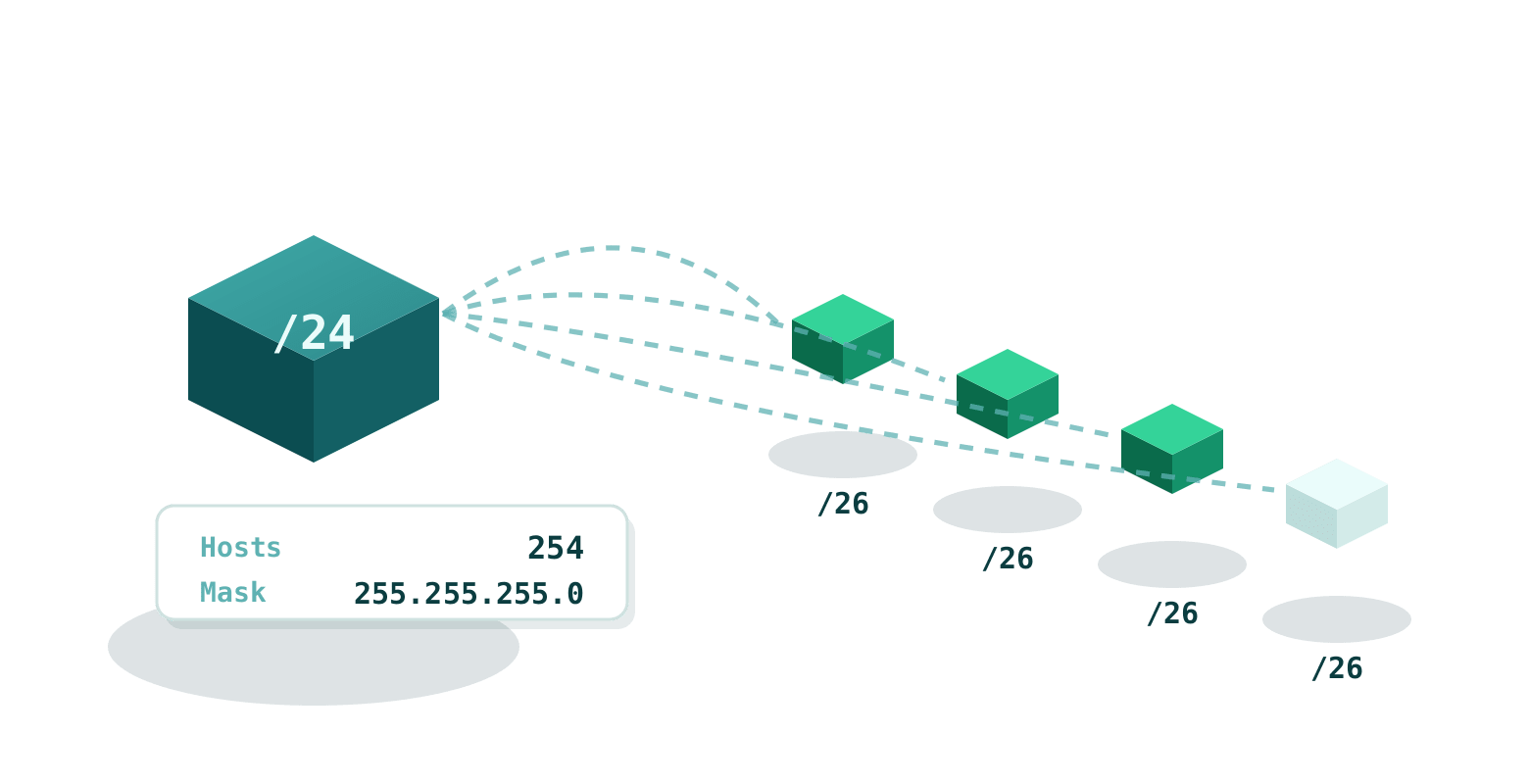
CIDR notation (Classless Inter-Domain Routing) expresses the subnet mask as a prefix length appended to the IP address with a slash. A /24 means the first 24 bits are the network portion and the remaining 8 bits can be assigned to hosts, giving 256 total addresses (254 usable). A /25 splits that in half. Each bit you add to the prefix doubles the number of subnets and halves the host count per subnet.
The wildcard mask is the binary inverse of the subnet mask and is used in access control lists (ACLs) on Cisco devices and in OSPF configurations to specify which bits of an address to match. A /24 wildcard is 0.0.0.255, meaning the first three octets must match exactly and the last octet can be anything.
IPv6 subnetting basics
IPv6 uses 128-bit addresses, making the arithmetic different but the concepts the same. The standard subnet size for a single LAN is a /64, which leaves 64 bits for interface identifiers and is required for SLAAC (Stateless Address Autoconfiguration). ISPs typically assign a /48 or /56 to a customer site. A /48 contains 65,536 possible /64 subnets, which is more than enough for any organisation.
IPv6 does not use broadcast addresses. It uses multicast groups for equivalent functionality. The "last address" shown in the IPv6 results is the highest address in the prefix, not a broadcast. There is also no meaningful concept of "wasting" IPv6 addresses, since the address space is so large that even assigning a /64 to each point-to-point link leaves virtually the entire space untouched.