
IPv4 vs IPv6: Why the Migration Has Taken 30 Years (And Counting)
On March 28, 2026, something quietly historic happened. For one single day, IPv6 carried 50.1% of all traffic to Google. After that, it dropped back below half and has been hovering around 45-50% ever since.
Think about that for a second. IPv6 was published as RFC 2460 in December 1998. The protocol that was supposed to replace IPv4 took 28 years to handle half of Google's traffic for one weekend. By any reasonable measure, this is the slowest tech migration in the history of the internet.
So what happened? Why is the upgrade everyone saw coming since the 90s still not done?
A 30 second refresher on the difference
If you already know this part, skip ahead. If not, the basics:
IPv4 uses 32-bit addresses. That gives you about 4.29 billion possible combinations. The address looks like 192.168.1.1, four numbers separated by dots, each between 0 and 255. This is the format you've seen your whole life.
IPv6 uses 128-bit addresses. That gives you 340 undecillion combinations. Yes, undecillion is a real word. It's 340 followed by 36 zeros. The address looks like 2001:0db8:85a3::8a2e:0370:7334, eight groups of hex separated by colons.
The math on the address pools: if every grain of sand on Earth needed an IP address, IPv4 couldn't cover one beach. IPv6 could give every atom in your body its own address and still have plenty left over.
Why IPv6 was created in the first place
The IETF saw this coming back in the early 90s. They watched the internet explode, did some napkin math on 4.29 billion addresses, and realised it wasn't going to be enough. Work on a successor started in 1994. RFC 2460 was published in 1998. Job done, right?
Not quite.
The actual exhaustion timeline played out like this:
- February 2011 - IANA, the organization that hands out big chunks of address space to regional registries, gave out its last
/8block. The free pool at the top was officially empty. - April 2011 - APNIC (Asia-Pacific) ran out first.
- September 2012 - RIPE (Europe) ran out.
- June 2014 - LACNIC (Latin America) ran out.
- September 2015 - ARIN (North America) ran out.
- 2019 - AFRINIC (Africa), the last holdout, ran dry.
By 2019, every regional registry on Earth was in the same boat. New IPv4 allocations stopped. If you wanted addresses, you had to buy them from someone who already had them.
You'd think this would have triggered a mass migration to IPv6. It didn't. Adoption kept crawling along at maybe 5% a year. Why?
Where things actually stand in 2026
Let's look at the real numbers, because the global average hides a lot.
Google's stats put global IPv6 adoption at around 45-50%, depending on the day of the week. (It goes higher on weekends because home users are more likely to be on v6-enabled networks than office workers.) Cloudflare Radar reports 40.1% of HTTP requests come over IPv6. APNIC Labs measures around 43% of networks as IPv6-capable.
But the country breakdown is wild:
- France: 86% (February 2026)
- India: 75%+ (driven mostly by Reliance Jio's mobile network)
- Germany: 68%+
- United States: ~55%
- China: still under 30%
- Most of Africa: under 5%
The countries that adopted v6 fastest are mostly the ones that didn't get enough IPv4 in the first place. India never had enough addresses for thier population, so when mobile internet took off there in the 2010s, IPv6 was the only option that scaled. Same story in much of Asia.
Meanwhile the US and Europe, which got their pick of addresses back when registries were giving them away, are still dragging.
The real reasons it's so slow
Here's where it gets interesting. The technical reasons everyone repeats (legacy hardware, training, etc.) are real but they're not the main story. The main story is economic.
CGNAT bought IPv4 another 20 years
Carrier-Grade NAT is the single biggest reason IPv6 isn't urgent yet. Before CGNAT, every home connection needed its own public IPv4 address. Run out of addresses, can't add new customers, simple. With CGNAT, an ISP takes one public IPv4 address and shares it across hundreds or even thousands of subscribers, doing translation in the middle.
This works. Mostly. There are downsides (some games and P2P stuff break, port forwarding doesn't work, abuse tracking gets messier) but for the average user streaming Netflix and scrolling Instagram, you'd never notice. CGNAT essentially gave ISPs a way to keep adding customers without buying new IPv4 space and without rolling out IPv6.
When the internet's most pressing problem turns into "we can keep doing what we were doing, just slightly worse", the urgency for change evaporates.
There's no business case to migrate
This is the one nobody wants to say out loud. Migrating a network to IPv6 costs money. Hardware audit, configuration changes, monitoring updates, retraining staff, debugging weird edge cases for months. And what does the ISP get for spending all that money?
Nothing. Customers don't pay more for IPv6. They don't even know what it is. The ISP can't charge a premium. The network engineer who pushed for the migration doesn't get a bonus. The CFO sees a cost line with no matching revenue line.
Compare this to literally any other infrastructure upgrade. 4G to 5G? Carriers can charge more, market faster speeds, sell new phones. Fiber rollouts? Premium tier with higher prices. IPv6? Nobody notices, nobody pays.
IPv4 became a real asset class
This is wild but its true. IPv4 addresses are now traded like commodities. The first major sale was Microsoft buying 666,624 addresses from bankrupt Nortel in 2011 for $7.5 million. That's $11 an address.
Prices peaked in 2021-2022 at around $50-60 per address during the cloud and infrastructure frenzy. They've corrected since:
- Today (Q1 2026): $13-$28 per IP for
/16blocks (large), $25-$45 per IP for/24blocks (small) - Lease market: $0.30-$0.50 per IP per month
- Average
/16block fell below $20 per IP in mid-2025, and below $10 by February 2026
The free pool is functionally gone. About 3.9 million unallocated addresses remain across all RIRs, mostly stuck in AFRINIC and APNIC. The market is entirely secondary now, address holders selling or leasing to address users.
What this means: if you own IPv4 space, you have an asset that generates income. Cloud providers like AWS, Azure, and GCP started charging for public IPv4 addresses in 2024. Hetzner charges €1 per address per month. There is now a financial incentive to keep IPv4 alive, not to phase it out.
Legacy hardware that nobody's touching
A lot of the internet runs on stuff that was deployed years ago and is still working fine. Old routers, embedded devices, industrial control systems, ATMs, point-of-sale terminals, IoT gear from 2015 with firmware that hasn't been updated since. A lot of it doesn't speak IPv6 at all, and nobody is replacing it because it's not broken.
Industrial and enterprise networks are the worst offenders. Hospital networks, manufacturing floors, and bank back-ends often run on equipment that's a decade old or older. The cost of validating that all of it works on IPv6 is enormous, and the upside is zero (the equipment was working fine).
Dual stack means double the work
The migration path everyone uses is "dual stack", running both IPv4 and IPv6 at the same time on every device. This is supposed to be temporary. In practice it's been the steady state for fifteen years and counting.
Dual stack means twice the firewall rules, twice the monitoring, twice the troubleshooting surface, two routing tables, two sets of issues when something breaks. Network engineers spend their time keeping both protocols working instead of moving forward. There's a reason a lot of teams just add "IPv6 migration" to next year's roadmap and then push it again.
IPv6 isn't backward compatible. At all.
This is maybe the single biggest design decision that came back to bite the entire industry. An IPv4-only device cannot talk directly to an IPv6-only device. Period. They need a translator (NAT64, DNS64, application-level proxy, something).
If IPv6 had been designed as a backward-compatible extension of IPv4, the migration would have been gradual and natural. Instead, it was designed as a complete replacement, which means every endpoint, router, and server in the path has to support it before you can turn off IPv4. You're doing the migration for nobody until literally everyone else has also done it. Classic chicken-and-egg.
Three companies that actually moved the needle
Here's something the official adoption story usually skips. The IPv6 curve isn't smooth. Look at it closely and you'll see steps, not a slope. Each step ties back to a specific company making a specific decision, and three of them deserve most of the credit.
Apple, June 2016. Apple announced that every iOS app submitted to the App Store had to support IPv6-only networks. Not dual stack as a fallback, the app actually had to work on a network with zero IPv4 in the path. Hard deadline, no exceptions, get rejected from review otherwise. Thousands of developers had a few months to audit their networking code, fix hardcoded IPv4 assumptions, and ship updates. The corresponding bump in IPv6-capable mobile apps showed up in the data within the year.
Reliance Jio, September 2016. Jio launched in India as an IPv6-first mobile carrier. They didn't bother with much public IPv4 at all, just CGNAT for legacy stuff and pushed everyone straight onto v6. Three months in they had 50 million subscribers. By 2018, 250 million. A single operator rolling out a single design decision basically dragged India from sub-10% to 75%+ IPv6 adoption in a few years. No standards body, no government mandate, just one company that didn't want to deal with IPv4.
T-Mobile US. T-Mobile started moving its mobile network to IPv6-only with NAT64 doing translation back to v4 services around 2014. They were aggressive about it, and they were big. Now over 100 million US subscribers run on a network where most of the path is v6 and v4 only exists at the edge for compatibility. Verizon and AT&T followed reluctantly.
Compare these three decisions to a thousand RFCs, fifteen years of "IPv6 is coming" conference keynotes, and IETF working groups grinding away on transition mechanisms. Three corporate roadmap items did more than any of that combined.
What this means for you
If you're a normal user, the answer is "almost nothing". Your phone has been speaking IPv6 for years. Your home router probably is too if it's recent. Most major sites (Google, Facebook, Netflix, Cloudflare-fronted stuff) work over both. You'll never notice.
You can run a quick my ip to see what address you're shown right now. If it starts with 2 or 3, you're on IPv6. If it looks like four numbers with dots, you're on IPv4 (probably behind CGNAT if you're on a mobile or residential connection).
If you run a server, web app, or any kind of public service, things get more interesting. Adding IPv6 support is no longer optional in 2026. Some networks (looking at T-Mobile's IPv6-only mobile network in the US) reach you only via IPv6 these days. If your service is IPv4-only, you're invisible to those users, and the translation layer in between adds latency.
Will IPv6 ever fully replace IPv4?
Honestly? Probably not in this decade. Maybe not in the next one either.
What's more likely is what we have now becomes permanent: a hybrid internet where IPv6 handles most traffic, IPv4 sticks around for legacy systems, and CGNAT or NAT64 sits in the middle doing translation. The IPv4 market will keep functioning. Prices will keep softening as more services go pure IPv6, but the addresses will hold value because someone, somewhere, will always need them.
This is honestly the most likely outcome. COBOL is still running banks 60 years after it was invented. Mainframes are still in production. Old protocols don't die when somthing better comes along. They die when the last person who needs them retires, dies, or finally gets fired for stalling the migration.
IPv6 won't kill IPv4. It'll just slowly take over the workload while IPv4 quietly handles the long tail of things nobody wants to touch.
Wrap up
Thirty years to migrate a protocol is embarrassing. But it makes sense once you see the incentives. Nobody's been paid to make this happen, and the people who could pay (ISPs, hosts, content providers) all had cheaper workarounds. The result is the dual-stack mess we live in today.
The migration will keep happening. Just slowly. Like it always has.
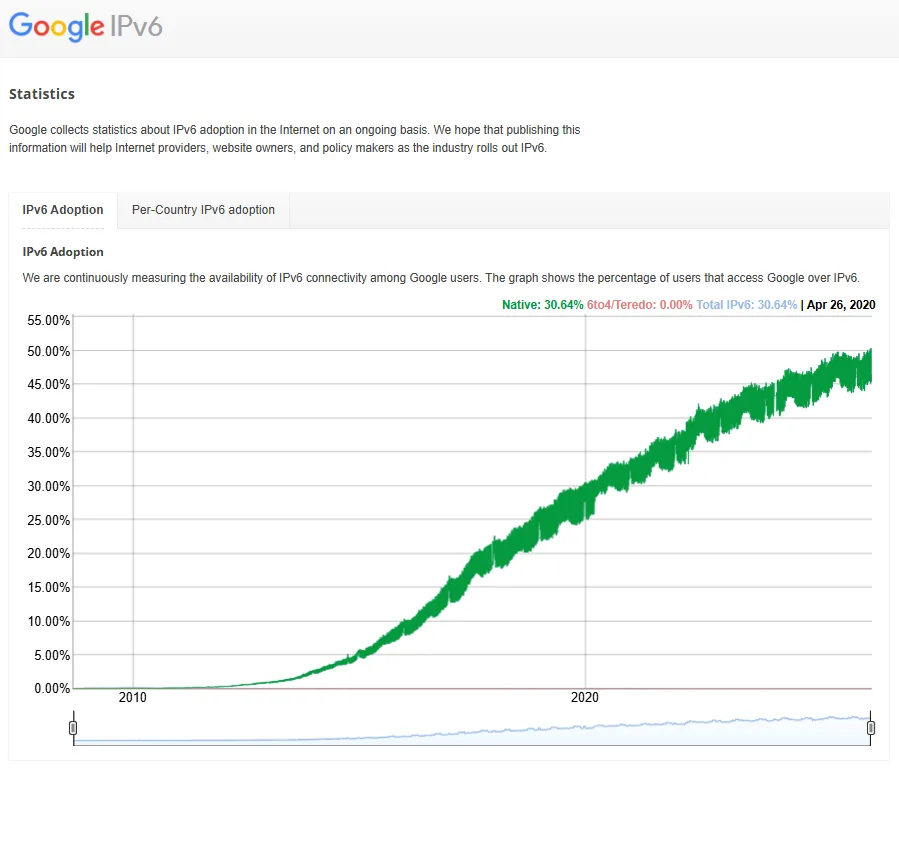 Google ipv6 statistic
Want to see how IPv6 adoption looks for your country? Check Google's IPv6 statistics page or APNIC Labs measurements. The trends since 2018 have been remarkably linear at about 10% growth every 3 years, so the math says full adoption is decades away if the curve holds.

Comments 0